


Did you know that you’ve been assigned a dedicated ONWARD Care Coordinator who will provide one-on-one support throughout your RYSTIGGO treatment? ONWARD Care Coordinators do not provide medical advice and will refer you to your healthcare professional for any questions related to your treatment plan.
By getting to know you and understanding your unique needs and situation, your Care Coordinator will provide personalized resources and one-on-one support to you and your caregivers during your prescribed treatment, if you choose to include them.
Scroll below to find your Care Coordinator’s bio and learn a little about them.

Ann
I have a Bachelor of Science in Nursing degree. I have eight years of experience in healthcare and I’m looking forward to learning more about you through this process. On my days off, I enjoy hiking and skiing with my friends.

Atzy
I have a Bachelor of Business Administration and Management, as well as a PharmD, RPh. I was a pharmacist for six years and I’ve worked in healthcare for a combined 25 years.

Autumn
I have a Bachelor of Science in Nursing and 24 years of experience in healthcare, with nine of those years spent as a nurse educator in the pharmaceutical industry.

Cicely
I have a Bachelor of Science in Nursing degree. I have 18 years of experience working in healthcare and I love being a support for my patients. When I’m not helping patients, I love live music and spending time with my family.

Irene
I’ve worked in the healthcare industry for the last 14 years, where I’ve developed a strong understanding of the patient’s needs and the importance of providing compassionate, quality support.

Megan
I have a Bachelor of Science in Nursing with 12 years of healthcare experience. I love being a Care Coordinator because it allows me to make connections and provide support during challenging times.

Melinda
I have a Bachelor of Science in Nursing and 12 years of experience working in the healthcare industry. Knowing that I can assist through a difficult time is why I love working with patients.
Schedule Time With Your Care Coordinator
You can book 15- and 30-minute check-in calls with your Care Coordinator using the “Schedule now” button below. Please click it to choose a session and select your Care Coordinator from the dropdown menu. You can then select the day and time that best fits your schedule.
Not sure who is your ONWARD Care Coordinator?
Call 1-844-ONWARD1 (1-844-669-2731) to get your Care Coordinator information.
Your ONWARD Care Coordinator is here to help.
You can contact them Monday through Friday, 8 AM – 8 PM ET.

Do you sometimes feel unsure about your treatment, or have questions about how much it’s really helping you? Living with generalized myasthenia gravis (gMG) can be very challenging. You may find yourself wondering how important it is to continue taking treatment prescribed to you.
This is all understandable. Most people can see advantages and disadvantages in any treatment they’re taking.
- You sometimes miss an infusion appointment – you may find that you forget an appointment occasionally, but if it happens regularly, one reason could be that you have some doubts about your treatment
- You haven’t managed to make your treatment part of your routine – for example, you might find yourself putting off scheduling your next appointment
- You feel negative about your treatment
If you're having any difficulties with your treatment, talk to your healthcare team as soon as possible. They can support you to:
- understand what to expect from your treatment
- get a more balanced view of your treatment
- make informed decisions
- take your treatment the correct way
- make your treatment a habit – when you’re getting used to a new treatment, it can seem like a lot of effort, but your healthcare team can help you make it part of your routine
The simple tips below can help you understand and reflect on your feelings about your treatment. You can discuss your insights with your healthcare team.
Write down any questions you have about your treatment and the benefits you see of taking it. This can help you understand the different feelings you may have, so that you can share them with your doctor.
Sometimes, the way you think can affect how you feel about your treatment. It’s normal to think more negatively about things when you’re feeling low. If you notice you’re having negative thoughts about your treatment, try writing them down to discuss with your healthcare team.
Your mood can have an impact on how you think and feel about your treatment. Research has found that depression and anxiety can get in the way of taking medicine, so speak to your healthcare team if you think this may be an issue for you. They can offer support, such as talking therapies and advice on lifestyle steps that may help, like exercise.
Your healthcare team may also point you toward gMG support groups. You may enjoy speaking to others who understand what you’re going through.
It’s important to have people in your life you can open up to. Friends and family members may also have a different view of how you’re getting on with your treatment. They may be able to see that symptoms are improving when it’s not so clear to you, for example.

It’s important to stick to the recommendations from your healthcare team, including taking your medications as prescribed. This is essential for all medications to work as intended.
For RYSTIGGO, this means attending all your treatment cycle infusions: 6 infusions per cycle, given once a week for 6 weeks.
Follow the recommendations from your healthcare team as closely as possible. Using a long-term treatment can sometimes cause people to get discouraged, but don’t give up. Your healthcare team can support you to get into a good routine with your medicine.

Missing infusions means there will be less medicine in your body, which could make it
less effective than taking it as directed. If you miss a dose, contact your doctor
immediately for advice and to schedule another appointment to receive RYSTIGGO
within the next 4 days. Then go back to your usual dosing schedule until the treatment
schedule is completed.
What if I start feeling better during a cycle of RYSTIGGO treatment?
Talk to your doctor about these feelings before deciding to stop your treatment.

Every 6-week cycle is followed by a break in your RYSTIGGO treatment. During this break, you can work with your doctor to plan for future cycles, if needed.

Tracking your symptoms is an important part of your treatment plan. By documenting your symptoms regularly, you can help tell your healthcare provider how symptoms are impacting your life.
When you write down your symptoms every day, you can accurately and effectively communicate with your healthcare provider about your gMG. Tracking only takes a few minutes each day and can help guide your treatment path in a positive, constructive way.
The Myasthenia Gravis Activities of Daily Living (MG-ADL) scale is used to measure your gMG symptoms. This tool assesses the impact of MG on your daily functions and communicates your symptoms to your healthcare provider.
Make sure you discuss how frequently you should track your symptoms with your healthcare provider. Once you’ve tracked how your symptoms appear, make sure you bring that information to your appointments.
ONWARD has developed a treatment journal with the MG-ADL tool you can use to track your symptoms. The Starting Strong RYSTIGGO Treatment Journal contains helpful information, including week-by-week treatment topics and tips for turning the results of your symptom tracking into meaningful conversations with your doctor and healthcare team.
Work with your healthcare provider to determine how often you should be tracking.

Following your first prescribed treatment with RYSTIGGO, you may have more focused conversations with your healthcare provider. You may want to dedicate part of your appointment time to talk about topics such as how you are feeling and how you are managing your generalized myasthenia gravis (gMG) with RYSTIGGO.
Whether you want to prepare for an in-depth chat or simply take some quick notes, we have Doctor Discussion Guides to help you make the most of your visits.
Take control of the conversation with the interactive RYSTIGGO Doctor Discussion Guide
Make the most of your next doctor visit with this interactive tool that helps turn everyday questions into clear talking points so your doctor understands what matters most to you.

Click, print, and go with the
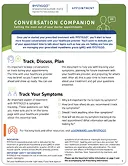
RYSTIGGO Conversation Companion
Prefer to keep the conversation in your own words? Download the RYSTIGGO Conversation Companion for similar, simpler guidance.

Most people with generalized myasthenia gravis (gMG) have times when their symptoms get worse, even when they’re on treatment. These times are known as flares or flare-ups. You may also sometimes hear them called exacerbations.
In a recent study of patients with gMG, the most frequently reported symptoms were eyelid drooping (reported by 93% of study participants), physical fatigue (89%), symptoms affecting the legs (82%), difficulty breathing (82%), and difficulty holding head up (82%).
A flare-up is when the weakness in some or all of your muscles happens more often or is more severe than usual. It can be mild, moderate, or severe. Signs of a flare-up include any of the following symptoms getting worse:
- Trouble swallowing or speaking
- Trouble breathing or shortness of breath
- Trouble walking or holding onto things
- Droopy eyelids or double vision
- Feeling very tired
Understanding what makes your symptoms better or worse can be helpful when you’re managing a long-term condition. Identifying triggers can help you to:
- understand your gMG so that you can manage it in a personalized way
- feel more empowered and confident about managing gMG
- be more proactive in managing your symptoms day to day
Tracking can help you to identify your triggers. This means regularly keeping a note of your symptoms and anything that makes them better or worse. It’s often easier to see these patterns when you have a record you can look at.
You can track in any way that works for you, for example:
- keeping notes in a standard diary
- using your calendar app
- typing notes on your computer or phone
- using a speech-to-text app – this could be helpful if writing or typing is difficult
The notes don’t have to be long and can include your symptoms — noting when you experience them, what you’ve been doing – for example, any physical activity, what you’ve eaten, your mood, or any external factors you’ve noticed like hot/cold temperatures, illness, or lack of sleep.
You can’t always avoid triggers, but you can often take steps to limit some of them. Here are some quick tips for managing common triggers.
- Prevent poor sleep with some good bedtime habits. Try to get up and go to bed
at regular times and make sure your bedroom is quiet, dark, relaxing and at a
comfortable temperature. - While you can’t always avoid catching a cold or flu, ask your healthcare team
about the steps you can take to lower infection risk. These may include having
an annual flu vaccine and other vaccines your healthcare team advises. Always
get their advice before you have a live vaccine, which is one that contains
weakened viruses or bacteria. - Find ways to cope with stress. Stress is a common trigger in gMG and often an
unavoidable part of life. Worsening symptoms can be a cause of stress, creating
a vicious cycle. It can be managed through mindful approaches and proactive
coping strategies. Here are a few techniques for coping with stress that you may
find useful:- Tackle one source of stress at a time – Identify and manage the most apparent
source of current stress; once dealt with, move onto the next. This is much
easier than trying to deal with everything at once. - Indulge in your favorite creative outlets – Put aside time for a creative hobby
you enjoy, or start a new one. It’s not about simply filling time. A hobby can be a
powerful form of escapism. Find a relaxing activity you’re passionate about, such
as art, music, reading or watching sport – it can be extremely calming and self-
affirming. - Tap into your support network – Being around the people who support you and
are important in your life can be hugely beneficial. They may be open to talking
about your stresses but their companionship alone can be enough to reduce
stress and shift your focus towards the positive. - Speak with a counselor – Having a sounding board to unload some stress can
really help. Friends and family members may instinctively try to offer solutions,
which is not always what you need. Sometimes it’s good to just get things off
your chest with a counselor who is an expert listener. - Humor – It would be too easy to suggest that you can simply laugh away your
stress, but laughter really is good for the soul. Having a sense of humor and
seeing the funny side of daily events is more powerful than you may think.
- Tackle one source of stress at a time – Identify and manage the most apparent
Talk to your healthcare team about any extra support you need with managing
sleep, stress, or other triggers. If you’re finding it difficult to manage stress, or you
have any other questions, speak to your healthcare team as you may need some
extra support. Support groups for people with gMG can be really valuable, too.
A myasthenic crisis is a potentially life-threatening complication of gMG. It
happens when muscle weakness gets worse and makes breathing difficult, so
you need support in hospital to breathe. It’s estimated that approximately
15-20% of people with gMG have a myasthenic crisis at least once in their lives.
Here are some important points to know:
- Manage your triggers
Anything that makes your symptoms worse can potentially lead to a myasthenic
crisis. Infections are the most common triggers. It’s helpful to know your triggers
and manage them where possible, although there’s no obvious cause for
myasthenic crisis in one-third to one-half of people. - Know the signs
Your healthcare team can tell you about serious warning signs. Make sure you
know how to get emergency help. - Get support for symptoms
Myasthenic crisis typically develops after days or weeks of worsening symptoms,
so always speak to your healthcare team if you think your symptoms are getting
worse. - Stay on track
Work with your healthcare team to keep to your treatment plan. They can
support you to lower your risk of both flare-ups and myasthenic crisis.